
What does it take to turn a modern data platform into real business value? At the 10th Snowflake Prague User Group, hosted by Philip Morris International (PMI) on November 4, we explored the latest Snowflake innovations, compared different architectural approaches, and saw how business users are becoming active creators of data and AI solutions.
The evening brought together the Czech Snowflake community for live demonstrations, practical experiences, and discussions about how organizations are using the platform in very different ways.
Three sessions offered particularly interesting perspectives: Snowflake's latest capabilities, a panel discussion with Philip Morris International and Rohlik Group, and Organon's journey from traditional reporting towards AI-powered self-service.
Snowflake is evolving beyond traditional data engineering
The opening session, presented by Jan Láznička and Jan Difko from Billigence, introduced several new Snowflake capabilities, many still in preview.
Pipeline Builder brings a visual approach to building data pipelines using notebooks, SQL, and Python files. Openflow Gen2 simplifies data ingestion through improved connector configuration and connectivity options.
On the AI side, Cortex AI Gateway provides a centralized way to access models through existing AI development tools, while maintaining Snowflake's access controls, usage tracking, and logging.
Business Ontology connects business terminology directly to Snowflake objects, helping bridge the gap between technical data structures and business meaning. Meanwhile, Snowflake Dashboards enable users to create dashboards within the platform, including through conversational AI.
What makes these developments interesting is not any individual feature, but the direction they represent. Snowflake is increasingly bringing data engineering, analytics, AI development, and business context into a shared environment.
For data teams, this creates new opportunities, but also new considerations around governance, integration with existing tools, and the practical adoption of features that may not yet be available across all environments.
One platform, very different architectures
The panel discussion with Michal Vilímek from Philip Morris International (PMI) and Ondřej Hubálek from Rohlik Group demonstrated how differently the same platform can be implemented.
PMI operates approximately 100 Snowflake accounts, reflecting its global, geographically distributed data architecture. Its approach builds on data mesh principles, with strong emphasis on secure data sharing, tagging, and dynamic data masking.
Rohlik, by contrast, operates with just two accounts, supporting a different organizational structure and operating model.
The differences extend beyond account strategy.
PMI primarily uses Snowflake as a data warehousing platform, supported by tools such as Power BI, Matillion, and dbt Cloud. Rohlik uses it across analytics, data processing, and machine learning, combining Snowflake with Airflow, Tableau, and internally developed solutions.
Rohlik also shared how AI is becoming part of its development workflows, including agents that can build solutions based on requests submitted through Slack.
The discussion highlighted an important lesson for data engineering teams: architecture decisions should reflect how an organization operates, not simply follow a reference design.
Account structure, cloud provider selection, warehouse management, and governance requirements all influence how easily a platform can evolve.
There is no single correct Snowflake architecture. What works for a globally distributed enterprise may look very different from what works for a fast-growing technology-driven company.
Organon: When business users become creators
The session presented by Tomáš Soukup, Director of IT Architecture at Organon, offered another perspective on the evolution of Snowflake.
Organon's journey illustrates a transition from Excel-based reporting towards self-service analytics, internal Streamlit applications, and AI-powered solutions.
Today, the organization has 21 AI agents in production, supported by 74 semantic views — an example of how AI capabilities can move beyond experimentation into everyday business use.
But the most interesting part of this story is not the number of agents. It is the changing relationship between business users and technology teams.
Traditionally, business experts describe their requirements, while data and IT teams translate them into reports or applications. Organon's approach moves towards a model where domain experts participate more directly in defining business logic, validating queries, and creating the solutions they need.
The semantic layer plays an important role by connecting technical data with business definitions that experts can understand, validate, and maintain.
This makes self-service about more than providing access to data or tools. It is about giving business experts greater ownership of the knowledge and solutions they work with, while technology teams provide the platform, engineering foundations, and governance.
For us at UD4D, this session was particularly meaningful. Our team actively contributes to the Organon initiative presented during the meetup, so seeing this work shared with the wider Snowflake community was a rewarding moment.
It also reinforced something we see in practice: successful data and AI solutions depend not only on technology, but on close collaboration between data engineers and the people who understand the business.
What we took away
Across all three sessions, one takeaway stood out: technology creates possibilities, but business context, good architecture, and collaboration with domain experts are what turn those possibilities into real value.
For PMI, that means supporting a globally distributed data ecosystem with strong governance and secure data sharing. For Rohlik, it means enabling flexible analytics, machine learning, and increasingly AI-assisted development. For Organon, it means empowering business experts to move from consuming reports towards actively shaping their own data and AI solutions.
Different priorities, different architectures, and different journeys — all built around the same platform.
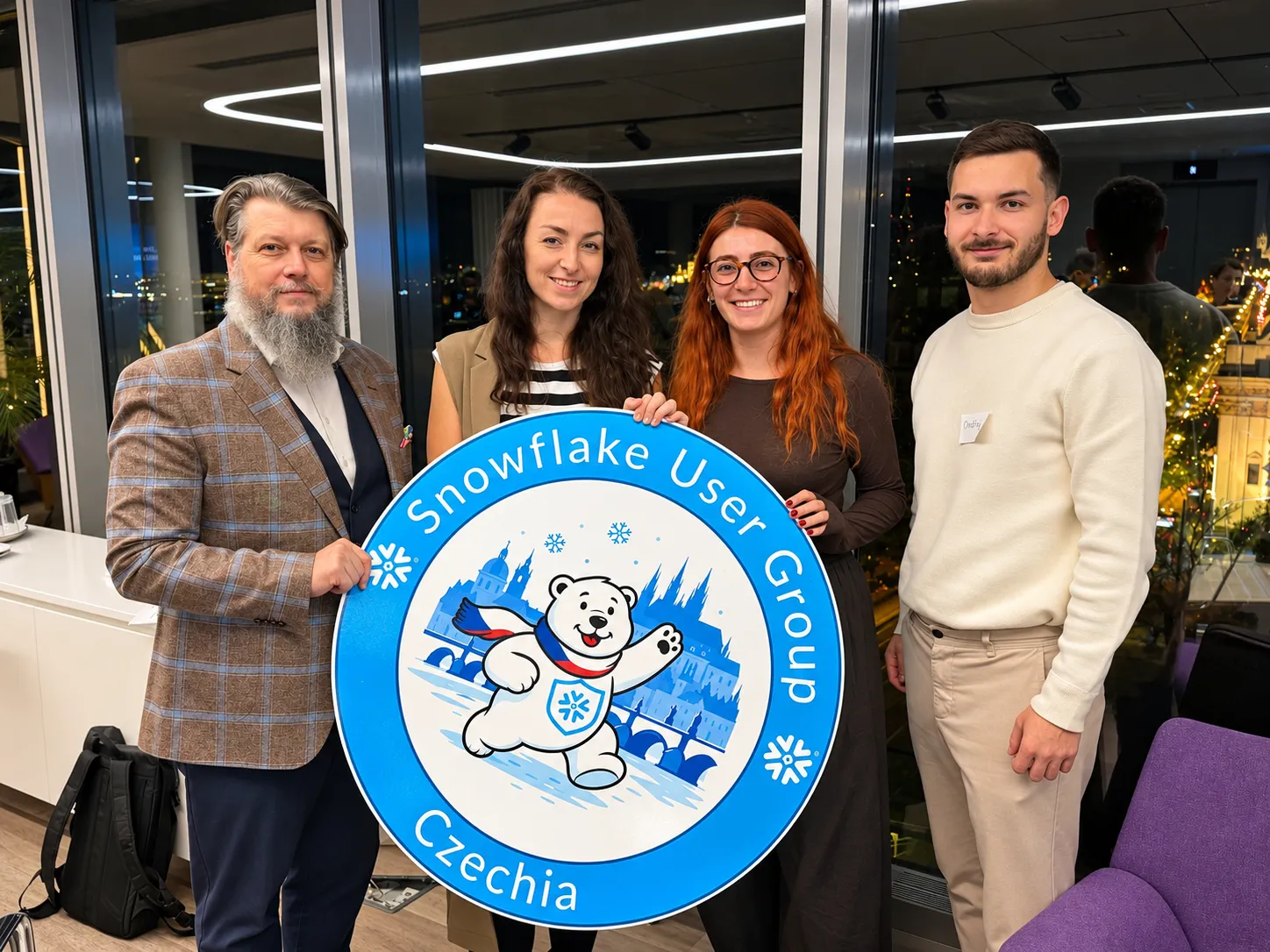
The evening concluded with the traditional Snowflake quiz and a cake celebrating the community's 10th Prague meetup.
Thank you to the organizers, speakers, and everyone who contributed to the discussions. It was a great opportunity to exchange experiences and see how the Czech Snowflake community continues to evolve.
Frequently asked questions
What were UD4D's key takeaways from Snowflake Prague User Group #10?
Technology creates possibilities, but business context, good architecture and collaboration with domain experts are what turn them into real value. PMI, Rohlik Group and Organon demonstrate how differently organizations can use the same platform to meet their needs.
Is there a single best approach to Snowflake architecture?
There is no one-size-fits-all architecture. As the examples shared at Snowflake Prague User Group showed, organizations can use the same platform in very different ways. Account structure, governance and technology choices should reflect how each organization operates and what it needs to achieve.
What role does a semantic layer play in self-service AI?
A semantic layer connects technical data with business definitions that domain experts can understand, validate and maintain. At Organon, 74 semantic views support 21 AI agents in production. This gives business experts greater control over the solutions they use, while technology teams provide the platform, engineering foundations and governance.