
AI can turn data management from a cost-and-risk maze into measurable business value. It can optimize cloud spend, predict and help prevent pipeline failures, de-duplicate customer records into a single golden record, and make data transformations traceable, helping deliver real financial and operational gains rather than hype.
When it comes to managing data, businesses often find themselves facing a complex maze of systems, budgets, and unpredictable challenges. With data constantly evolving and expanding, getting it right can seem like a never-ending struggle.
But imagine a scenario where artificial intelligence (AI) steps in to streamline operations, reduce costs, prevent data mishaps, and enhance customer experiences. This isn’t just some far-off vision, it’s already happening. AI is driving real, measurable results for organizations across various industries.
This is further supported by a recent Accenture report, which reveals that 84% of C-suite executives believe leveraging AI is essential to achieving their growth objectives.
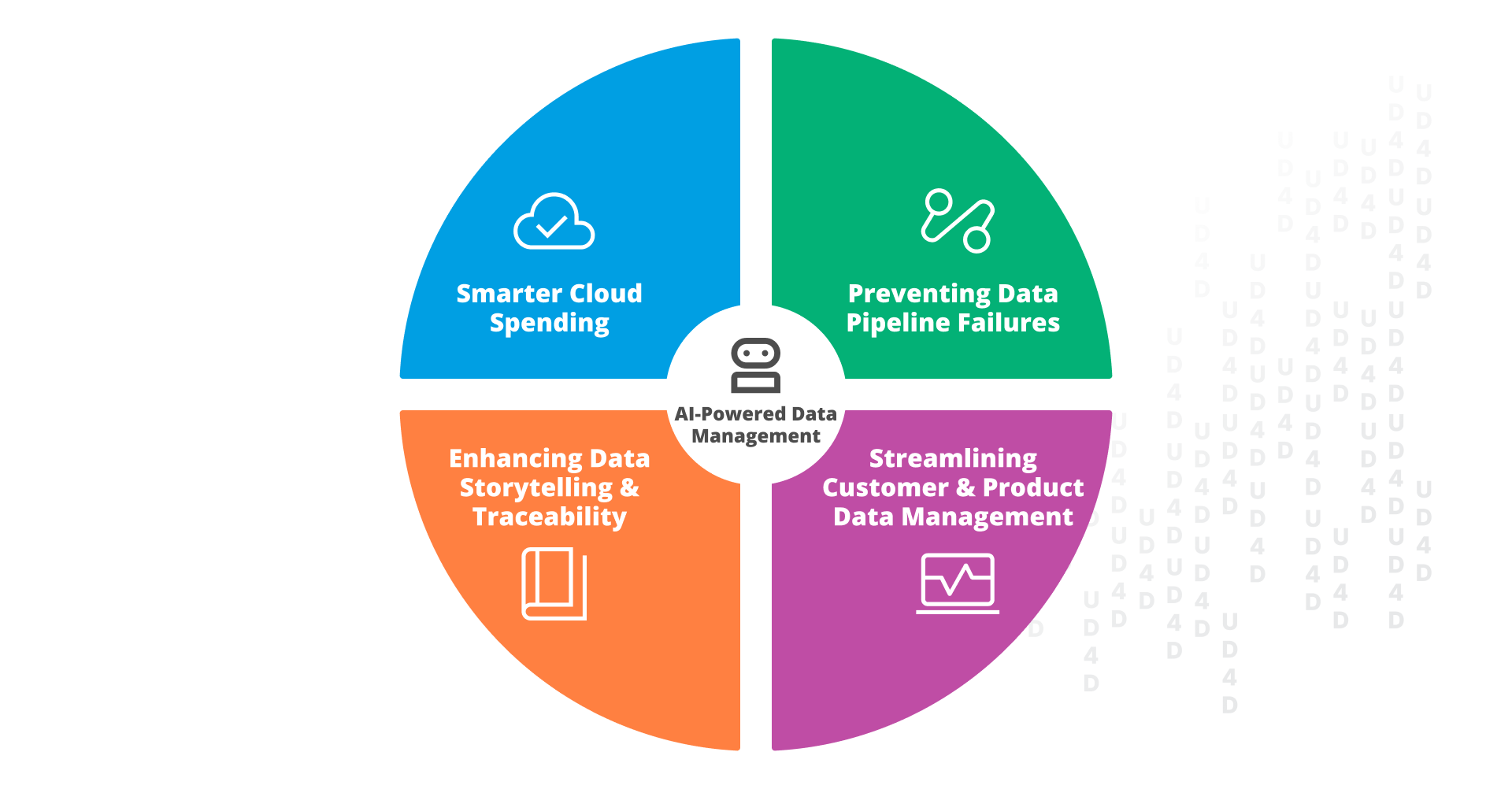
Smarter cloud spending with AI
A significant challenge for many organizations lies in cloud spending. McKinsey & Company report indicates that up to 30% of cloud resources go underutilized, resulting in wasted costs, particularly when storage and processing needs fluctuate unexpectedly.
AI addresses this issue by:
- Predicting future usage patterns to optimize spending.
- Identifying wasteful data processes that drain budget.
- Providing recommendations and predictions to adjust resources based on real-time demand.
Important: AI offers valuable insights and guidance, but budget control and final configurations remain in the hands of IT or cloud architects.
By leveraging AI recommendations, businesses can ensure that their resources are allocated efficiently, cutting down on unnecessary cloud costs while maintaining optimal performance.
AI for preventing data pipeline failures
Reliable data pipelines are critical for analytics and informed decision-making. However, when these pipelines fail, it can bring business operations to a standstill, compromising the ability to make informed decisions. Traditional monitoring systems often notify teams only after a failure occurs, leaving little room for proactive solutions.
A recent Censuswide survey of 200+ data leaders found that 45% faced 11 to 25 data pipeline failures over two years, often due to late-discovered errors or data quality issues.
AI flips the script by:
- Learning typical operational patterns of data pipelines to detect anomalies.
- Predicting failures before they happen, allowing teams to act swiftly.
By anticipating potential failures, AI empowers companies to take early action, ensuring seamless data flow and uninterrupted decision-making.
Streamlining customer & product data management
Customer data is often scattered across various systems: websites, mobile apps, CRM systems, and more. This creates inconsistent, duplicate, or incomplete records, which can lead to inefficiencies and a poor customer experience.
AI helps by:
- Identifying duplicate records, even when names or formats differ.
- Merging duplicates into a single, accurate ‘golden record’ for each customer.
With more reliable data, businesses can run more targeted marketing campaigns, improve customer interactions, and cut down costs on redundant communications.
According to Deloitte Digital, a large bank used data-driven AI to offer personalized reward programs, predicting customers' redemption preferences, resulting in a 40% increase in reward program usage. Additionally, other banks have employed next-best action models to predict customers' needs and personalize services, boosting sales by nearly 30%.
Enhancing data storytelling & traceability
In many organizations, data drives decision-making. But tracing where that data comes from and how it’s been transformed can often be a challenge. This lack of traceability can cause distrust in data, especially when it comes to industries with strict regulatory requirements.
AI offers a solution by ensuring full data traceability:
- Tracking every transformation a piece of data undergoes.
- Creating visual maps of data flow, from source to final report.
Whether it’s for regulatory compliance or making informed decisions, AI ensures transparency. For example, in auditing, AI enhances anomaly detection by eliminating the limitations of traditional sampling methods. Instead of manually reviewing a fraction of financial transactions, AI enables full-scale analysis of entire datasets, identifying irregularities and potential risks with greater accuracy. This allows auditors to detect fraud, errors, or compliance issues more effectively, ensuring a more thorough and reliable audit process.
The bottom line: Smarter data, stronger business
AI isn’t just a buzzword: it’s a game-changing tool that helps organisations save money, prevent failures, clean up messy data, and build trust in decision-making. In today’s competitive landscape, leveraging AI-powered data management is no longer a luxury. It’s an essential strategy for businesses looking to achieve real, measurable financial and operational benefits.
Frequently asked questions
How does AI reduce cloud costs?
AI can predict future usage patterns, identify wasteful data processes, and recommend resource adjustments in real time. It advises, though budget control and final configuration stay with IT or cloud architects.
Can AI prevent data pipeline failures?
Yes. AI can learn a pipeline's typical operational patterns to detect anomalies and predict failures before they happen, so teams can act proactively instead of reacting after a break.
What is a 'golden record' and how does AI create it?
It is a single accurate profile per customer. AI can identify duplicate records even when names or formats differ and merge them, which helps improve targeting and cut redundant communication costs.
How does AI improve data traceability and audits?
AI can track transformations and map data flow from source to final report. In auditing it can analyze entire datasets instead of samples, helping detect irregularities and compliance issues more reliably.